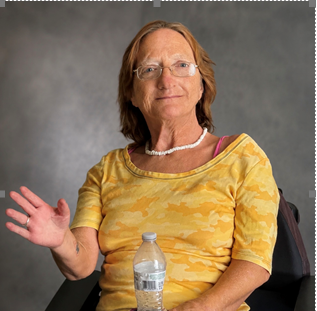

Colleen Mary Shaw (Koref) was born on August 22, 1961, the youngest child to Lorraine B. Shaw and Sheldon David Shaw and passed on July 13 2026.
From the very beginning, Colleen defied the odds. Born with Arthrogryposis Multiplex Congenita, she lived far beyond what the “experts” ever predicted. She didn’t just survive, she lived. She faced every challenge with determination, courage, and a fierce independence that became the hallmark of her life.
She walked. Boy, did she walk. Walking across the stage at her high school graduation was one of countless milestones she achieved that many thought impossible. Colleen spent her life proving that limitations existed only to be challenged, and she never allowed anyone else to define what she could or could not accomplish.
Throughout her life, Colleen held a variety of communications roles, most recently served as The President of Resident Council for the community she resided. Colleen made friends everywhere she went, and embraced every opportunity to experience the world around her. She drove her own car, maintained her independence, and lived life on her own terms. She also drove the rest of us just a little crazy with her endless love of the Jackson 5 and Kool & the Gang, music that seemed to follow her wherever she went.
Colleen had a true zest for life. She loved to dance, really dance, as though no one was watching. Her infectious laugh, quick wit, and unmistakable spitfire attitude could brighten a room and keep everyone on their toes. She was strong-willed, outspoken, and never afraid to say exactly what was on her mind.
Above all else, Colleen’s greatest joy was her family. Her daughter, Brittney and her granddaughter, McKenna, were the lights of her life and the center of her world. She loved them fiercely and unconditionally, celebrating every accomplishment, offering endless encouragement, and cherishing every moment she spent with them.
Colleen leaves behind a legacy of perseverance, laughter, resilience, and love. She taught those around her that life is not measured by the obstacles we face, but by the determination with which we face them.
She is survived by her daughter Brittney, son-in-law Scott, grand daughter McKenna, brothers, Raymond (Chris) Brown Sr., Fred Blinn, and Kenn Shaw; her sisters, Penny Shaw, Cathy Foss, Sally Rogers, Bunni Brislane, and Robin (Rick) Jackman; as well as many nieces, nephews, great-nieces, and great-nephews.
She was preceded in death by her parents, Sheldon David Shaw and Lorraine Shaw; her sisters, Wilma Shaw, Fran McNeill, and Barbara Robbins-Nisenoff; and her brothers, Sheldon Shaw Jr., Kevin Shaw.
Colleen will be missed every single day until eternity. Yet we find comfort in imagining her free at last, running, jumping, and dancing forever. Celebration of life information will be announced by the family.
And as Colleen would always say, “See you later, love ya, ciao!”
Research for Life
We firmly believe that the internet should be available and accessible to anyone, and are committed to providing a website that is accessible to the widest possible audience, regardless of circumstance and ability.
To fulfill this, we aim to adhere as strictly as possible to the World Wide Web Consortium’s (W3C) Web Content Accessibility Guidelines 2.1 (WCAG 2.1) at the AA level. These guidelines explain how to make web content accessible to people with a wide array of disabilities. Complying with those guidelines helps us ensure that the website is accessible to all people: blind people, people with motor impairments, visual impairment, cognitive disabilities, and more.
This website utilizes various technologies that are meant to make it as accessible as possible at all times. We utilize an accessibility interface that allows persons with specific disabilities to adjust the website’s UI (user interface) and design it to their personal needs.
Additionally, the website utilizes an AI-based application that runs in the background and optimizes its accessibility level constantly. This application remediates the website’s HTML, adapts Its functionality and behavior for screen-readers used by the blind users, and for keyboard functions used by individuals with motor impairments.
If you’ve found a malfunction or have ideas for improvement, we’ll be happy to hear from you. You can reach out to the website’s operators by using the following email
Our website implements the ARIA attributes (Accessible Rich Internet Applications) technique, alongside various different behavioral changes, to ensure blind users visiting with screen-readers are able to read, comprehend, and enjoy the website’s functions. As soon as a user with a screen-reader enters your site, they immediately receive a prompt to enter the Screen-Reader Profile so they can browse and operate your site effectively. Here’s how our website covers some of the most important screen-reader requirements, alongside console screenshots of code examples:
Screen-reader optimization: we run a background process that learns the website’s components from top to bottom, to ensure ongoing compliance even when updating the website. In this process, we provide screen-readers with meaningful data using the ARIA set of attributes. For example, we provide accurate form labels; descriptions for actionable icons (social media icons, search icons, cart icons, etc.); validation guidance for form inputs; element roles such as buttons, menus, modal dialogues (popups), and others. Additionally, the background process scans all the website’s images and provides an accurate and meaningful image-object-recognition-based description as an ALT (alternate text) tag for images that are not described. It will also extract texts that are embedded within the image, using an OCR (optical character recognition) technology. To turn on screen-reader adjustments at any time, users need only to press the Alt+1 keyboard combination. Screen-reader users also get automatic announcements to turn the Screen-reader mode on as soon as they enter the website.
These adjustments are compatible with all popular screen readers, including JAWS and NVDA.
Keyboard navigation optimization: The background process also adjusts the website’s HTML, and adds various behaviors using JavaScript code to make the website operable by the keyboard. This includes the ability to navigate the website using the Tab and Shift+Tab keys, operate dropdowns with the arrow keys, close them with Esc, trigger buttons and links using the Enter key, navigate between radio and checkbox elements using the arrow keys, and fill them in with the Spacebar or Enter key.Additionally, keyboard users will find quick-navigation and content-skip menus, available at any time by clicking Alt+1, or as the first elements of the site while navigating with the keyboard. The background process also handles triggered popups by moving the keyboard focus towards them as soon as they appear, and not allow the focus drift outside it.
Users can also use shortcuts such as “M” (menus), “H” (headings), “F” (forms), “B” (buttons), and “G” (graphics) to jump to specific elements.
We aim to support the widest array of browsers and assistive technologies as possible, so our users can choose the best fitting tools for them, with as few limitations as possible. Therefore, we have worked very hard to be able to support all major systems that comprise over 95% of the user market share including Google Chrome, Mozilla Firefox, Apple Safari, Opera and Microsoft Edge, JAWS and NVDA (screen readers).
Despite our very best efforts to allow anybody to adjust the website to their needs. There may still be pages or sections that are not fully accessible, are in the process of becoming accessible, or are lacking an adequate technological solution to make them accessible. Still, we are continually improving our accessibility, adding, updating and improving its options and features, and developing and adopting new technologies. All this is meant to reach the optimal level of accessibility, following technological advancements. For any assistance, please reach out to