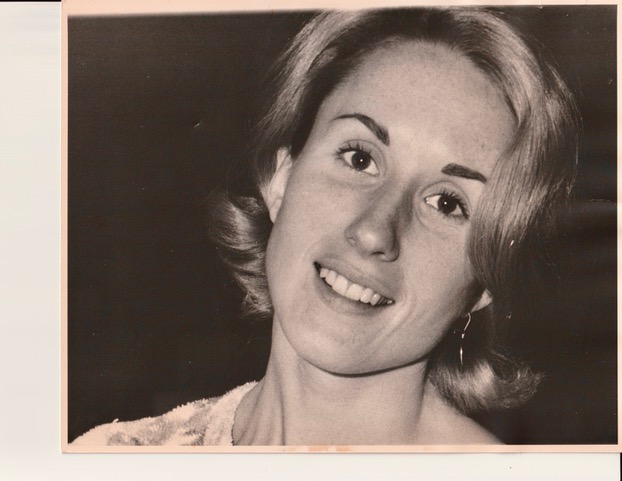

Dear friends and relatives,
Diane Elaine (Hamm) Eastman, aged 83, married to the same man for 60 years, passed peacefully from this place to some better one where her cancer is gone, at 1:05 PM, December 20, 2025. In her last minutes, she was with her best running/hiking friend of Peru and Patagonia and Galapagos, other friends, our nurse, and me.
Though not the outcome we wished and prayed for, she was in no pain and was in our garden room, her happy place. Jennifer and I wound a light string around the backyard for her to see, and we had stars projected on the ceiling. Chuck and Eileen brought a TV and set it up last weekend, and we had Christmas music nonstop.
Many of you came to see her in the skilled nursing facility, and here, and we value each and every one of you for showing how much you loved Diane. We have been blessed by flowers and dozens of cards wishing the best.
Diane was a remarkable woman, often self-effacing about her abilities, but willing to try about anything that came along. She was happy to spend 11 of our first 13 years of marriage putting hubby through (We called it the PHT), moving from New England to Texas, then to California as I followed my educational career.
She grew to be a wonderful manager, eventually as Director of Facilities and Operations at USC’s computer center. And this from someone who had limited technical background, but a good eye for the managers who did.
Diane started running for fitness while we were in Dallas, and once on the West Coast met with others similarly inclined. They called themselves the “out to lunch bunch” and were together for the better part of 20 years. Along the way Diane was encouraged to run a few short races by her friend Shiela and the rest is history. Those short races turned into marathons, then ultra-marathons, and Diane did her best to win something in almost all of them.
Diane’s first 100-miler, the Angeles Crest 100 could have been a disaster. She turned up hypothermic at the west end of Baden Powell, and collapsed into a chair. We revived her with blankets and soup, but worried that her race might be over. We underestimated the Iron Lady. Not only did she revive, she went on to be the women’s winner. Many other successes followed, with the culmination at the Vermont 100 in 1993. Diane was fourth woman overall, and set an over-50 course record which stood for well over a decade. We had friends and relatives in the crew, and shared the day with smiles and cheers. In 1993 she garnered an honorable mention in Runner’s World magazine for setting personal bests at all distances from 5K to 100 miles! You might know that most runners specialize at one or two distances. Not Diane!
Diane and her friend Julie shared three ultra-adventures to Peru and Patagonia, multi-day events with horses carrying the gear as they ran, sometimes at altitudes three miles high. She also did a week-long Sierra hike with friends Tony and Liz.
We traveled to Bordeau twice to do the Medoc marathon, with travel around with Chuck an Eileen as well. We rented a barge with our friends Dianne and Hans and another couple, running our own locks as we traveled the rivers.
Diane was a long-time volunteer at the Seal Beach Animal shelter, walking dogs and working with the staff in the cat house.
Starting with a teardrop trailer and finally, last year, progressing to a new RV, we camped across country more than a dozen times, usually ending up at the Cape Cod house, which my sister and I inherited from my parents. Last year, we had planned to visit the Blueridge Parkway, but Hurricane Helene had other ideas, and we spent three water-logged days driving across Tennessee.
We’ve had no lack of adventures, but we had hoped to take a couple of months next spring to fill in some blanks.
The hospice folks offered information on “researchforlife.org” and we intend for Diane, even in death, to make a contribution to medical knowledge. I think she would agree.
I am embarking on an entirely new part of life, without my compass. I expect things will be out of sorts for a while. But Diane would want me to continue all our friendships and activities, and I intend to do so. Your love and friendship will see me through the difficult times ahead.
And so, Diane’s physical body has been taken away, but her spirit will live in this house and in me forever.
Research for Life
We firmly believe that the internet should be available and accessible to anyone, and are committed to providing a website that is accessible to the widest possible audience, regardless of circumstance and ability.
To fulfill this, we aim to adhere as strictly as possible to the World Wide Web Consortium’s (W3C) Web Content Accessibility Guidelines 2.1 (WCAG 2.1) at the AA level. These guidelines explain how to make web content accessible to people with a wide array of disabilities. Complying with those guidelines helps us ensure that the website is accessible to all people: blind people, people with motor impairments, visual impairment, cognitive disabilities, and more.
This website utilizes various technologies that are meant to make it as accessible as possible at all times. We utilize an accessibility interface that allows persons with specific disabilities to adjust the website’s UI (user interface) and design it to their personal needs.
Additionally, the website utilizes an AI-based application that runs in the background and optimizes its accessibility level constantly. This application remediates the website’s HTML, adapts Its functionality and behavior for screen-readers used by the blind users, and for keyboard functions used by individuals with motor impairments.
If you’ve found a malfunction or have ideas for improvement, we’ll be happy to hear from you. You can reach out to the website’s operators by using the following email
Our website implements the ARIA attributes (Accessible Rich Internet Applications) technique, alongside various different behavioral changes, to ensure blind users visiting with screen-readers are able to read, comprehend, and enjoy the website’s functions. As soon as a user with a screen-reader enters your site, they immediately receive a prompt to enter the Screen-Reader Profile so they can browse and operate your site effectively. Here’s how our website covers some of the most important screen-reader requirements, alongside console screenshots of code examples:
Screen-reader optimization: we run a background process that learns the website’s components from top to bottom, to ensure ongoing compliance even when updating the website. In this process, we provide screen-readers with meaningful data using the ARIA set of attributes. For example, we provide accurate form labels; descriptions for actionable icons (social media icons, search icons, cart icons, etc.); validation guidance for form inputs; element roles such as buttons, menus, modal dialogues (popups), and others. Additionally, the background process scans all the website’s images and provides an accurate and meaningful image-object-recognition-based description as an ALT (alternate text) tag for images that are not described. It will also extract texts that are embedded within the image, using an OCR (optical character recognition) technology. To turn on screen-reader adjustments at any time, users need only to press the Alt+1 keyboard combination. Screen-reader users also get automatic announcements to turn the Screen-reader mode on as soon as they enter the website.
These adjustments are compatible with all popular screen readers, including JAWS and NVDA.
Keyboard navigation optimization: The background process also adjusts the website’s HTML, and adds various behaviors using JavaScript code to make the website operable by the keyboard. This includes the ability to navigate the website using the Tab and Shift+Tab keys, operate dropdowns with the arrow keys, close them with Esc, trigger buttons and links using the Enter key, navigate between radio and checkbox elements using the arrow keys, and fill them in with the Spacebar or Enter key.Additionally, keyboard users will find quick-navigation and content-skip menus, available at any time by clicking Alt+1, or as the first elements of the site while navigating with the keyboard. The background process also handles triggered popups by moving the keyboard focus towards them as soon as they appear, and not allow the focus drift outside it.
Users can also use shortcuts such as “M” (menus), “H” (headings), “F” (forms), “B” (buttons), and “G” (graphics) to jump to specific elements.
We aim to support the widest array of browsers and assistive technologies as possible, so our users can choose the best fitting tools for them, with as few limitations as possible. Therefore, we have worked very hard to be able to support all major systems that comprise over 95% of the user market share including Google Chrome, Mozilla Firefox, Apple Safari, Opera and Microsoft Edge, JAWS and NVDA (screen readers).
Despite our very best efforts to allow anybody to adjust the website to their needs. There may still be pages or sections that are not fully accessible, are in the process of becoming accessible, or are lacking an adequate technological solution to make them accessible. Still, we are continually improving our accessibility, adding, updating and improving its options and features, and developing and adopting new technologies. All this is meant to reach the optimal level of accessibility, following technological advancements. For any assistance, please reach out to